World Day – Background & Support
Find out more about the Alliance for Patient Safety (APS), the background to World Patient Safety Day, and the project funding provided by the Federal Ministry of Health.
What is World Patient Safety Day?
World Patient Safety Day is one of the WHO’s global health days. It was established on 17 September 2019 by the 72nd World Health Assembly following an initiative by the Action Alliance for Patient Safety (APS) and has been observed annually ever since.
World Patient Safety Day is the cornerstone of action to promote global health and safety. It is firmly rooted in the fundamental principle of medicine – ‘first, do no harm’. Its objectives are to raise public awareness and engagement, improve global understanding, and foster global solidarity and action among Member States to promote patient safety.
Key theme for 2025: ‘Childcare’
Children are particularly vulnerable. This applies above all to their medical care. However, those responsible and decision-makers in the healthcare sector still too often view their safety as patients from an adult perspective. It is therefore all the more encouraging that the WHO’s theme for this year’s World Patient Safety Day is ‘Safe care for every newborn and every child’.
Accordingly, the Action Alliance for Patient Safety (APS) will focus this year’s event, held on the traditional World Patient Safety Day (WTPS) on 17 September, on the safe care of children – under the slogan: ‘Patient safety from childhood – an investment for life’.
Children are not ‘little adults’
Children do not decide for themselves which healthcare facility to visit or which treatment method to use in the event of illness. They must rely on the care of their parents or guardians and the medical staff providing treatment and care. At the same time, the physical and psychological characteristics of children mean they should not be treated in a facility that lacks experience in dealing with children. This is because children experience a practice or clinic differently from adult patients and are not always prepared for treatment situations that they may find unpleasant.
Discussing projects and initiatives — protecting children
To mark this year’s World Patient Safety Day, we at APS would therefore like to reach out to all stakeholders and involve them in the discussion. We want to give a voice to parents, carers, and paediatricians and obstetricians. They should share their experiences and explain what, in their view, is working very well, moderately well and less well in which areas. As the APS, however, our aim is not merely to repeatedly highlight – often the same – shortcomings in the healthcare system, but also to highlight the predominantly positive aspects and successes, and thus to specifically eliminate systemic weaknesses and risks to patients – not only in the case of children.
The symbol of World Patient Safety Day: the safety pin and the colour orange
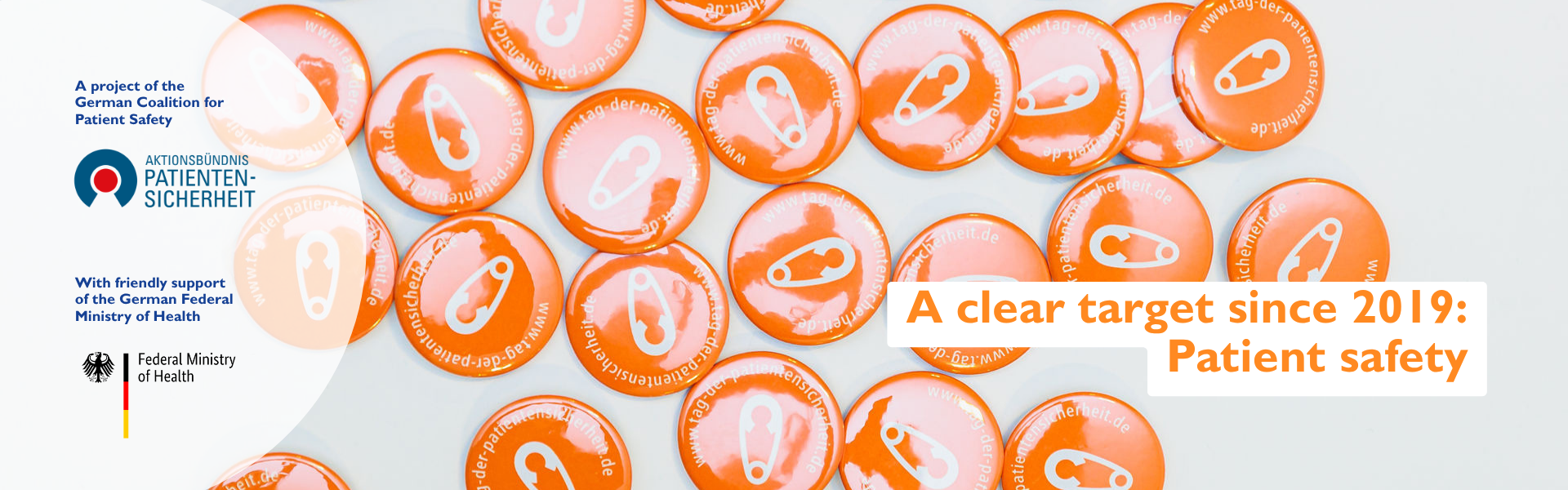
The APS safety pin and the high-visibility orange colour of patient safety symbolise a commitment to raising awareness of patient safety among healthcare professionals and the general public, whilst also calling on everyone to take an active role in improving patient safety.
Every year, the APS calls on people to help raise awareness of this important issue through campaigns and information events centred around World Patient Safety Day. Join in!
What is patient safety?
The overarching aim of patient safety is to improve the quality of healthcare and to ensure that patients do not suffer avoidable harm as a result of medical treatment. Here are some key elements of patient safety:
Error prevention:
Identifying and eliminating potential sources of error in medical care to prevent, for example, misdiagnosis or medical errors such as surgical mix-ups, patient mix-ups or medication errors.
Safety culture:
Promoting an open and transparent culture within healthcare organisations, in which errors and near-misses are reported and used as learning opportunities.
Risk management:
Conducting systematic analyses of treatment processes and outcomes to identify risks and develop measures to minimise them.
Patient involvement:
Involving patients and their relatives in decision-making processes to take their perspectives and experiences into account and enhance the safety of care.
Continuing education and training:
Providing ongoing education and training for healthcare staff to raise their awareness of patient safety and improve their ability to manage safety risks.
Standardisation of procedures:
Implementation of and adherence to guidelines, protocols and standards that promote best practice in patient safety.
Use of technology:
Use of technological solutions, such as electronic health records and computer-based decision support systems, to reduce errors and improve patient safety.
What is the Action Alliance for Patient Safety (APS)?
As a neutral and non-profit organisation, the APS plays a key role in improving patient safety in Germany by disseminating knowledge, fostering dialogue, and offering and supporting concrete measures to prevent errors and minimise risks.
The main activities of the APS include:

Promoting exchange and collaboration:
The APS brings together various stakeholders in the healthcare sector to share knowledge and experience and to develop joint strategies for improving patient safety.

Development of recommendations for action and patient information:
The APS develops and publishes recommendations designed to support healthcare facilities in implementing safety-related measures and to enhance patients’ health literacy.

Education and awareness-raising:
The APS carries out educational work to raise awareness of the importance of patient safety. This is achieved through media coverage, publications, events and campaigns.

Research and projects:
The APS initiates and participates in research projects and studies on patient safety in order to promote evidence-based solutions and innovations.

Policy work:
The APS advocates for the establishment of a national never-event register and contributes to legislative changes by issuing statements and participating in public consultations.
Further information about the Alliance for Patient Safety (APS) can be found on the website:
The main activities of the APS include:
#GermanyRecognisesSepsis
The campaign by the Alliance for Patient Safety and its partners focuses on the prevention, recognition, treatment and aftercare of sepsis. A rapid and accurate diagnosis of sepsis saves lives!
deutschland-erkennt-sepsis.de
Voices for Patient Safety
Patients share their experiences regarding patient safety in video messages. These messages are intended to encourage people to speak up about incidents, to play an active role in their treatment, and to champion a strong culture of safety at every level of the healthcare system.
stimmen-fuer-patientensicherheit.de
APS guidelines and patient information
The guidelines and patient information produced by the APS working groups are available free of charge to healthcare organisations and interested parties.
aps-ev.de/Handlungsempfehlungen
aps-ev.de/Patienteninformationen
Membership and donations
The Action Alliance for Patient Safety (APS) is funded in its core work by membership fees and donations. Currently, around 800 members support the APS. New members are very welcome! You can find information about membership at:
https://www.aps-ev.de/mitmachen/mitglied-werden
You are welcome to support the APS with a donation:
Donations account
Aktionsbündnis Patientensicherheit e.V.
IBAN DE93 3006 0601 0005 5751 11
BIC DAAEDEDDXXX
APO Bank
Project funding
The Federal Ministry of Health is supporting the APS in organising and coordinating World Patient Safety Day in Germany.
Funding reference:
To be announced shortly
Funding amount:
To be announced shortly
Funding period:
To be announced shortly
Funded measures
- 1 HR department (45 %)
- Website tag-der-patientensicherheit.de
- Website patient-safety-day.org
- Public relations
- Press relations, including press conferences
- Provision of digital and print materials free of charge to participating organisations and individuals (flyers, social media kits, guidance documents, patient information, etc.)
- Organisation of the main event on 17 September 2024 in Berlin