World Day – Background & Support
Find out more about the Alliance for Patient Safety (APS), the background to World Patient Safety Day, and the project funding provided by the Federal Ministry of Health.
What is World Patient Safety Day?
World Patient Safety Day is one of the WHO’s global health days. It was established on 17 September 2019 by the 72nd World Health Assembly following an initiative by the Action Alliance for Patient Safety (APS) and has been observed annually ever since.
World Patient Safety Day is the cornerstone of action to promote global health and safety. It is firmly rooted in the fundamental principle of medicine – ‘first, do no harm’. Its objectives are to raise public awareness and engagement, improve global understanding, and foster global solidarity and action among Member States to promote patient safety.
World Patient Safety Day 2026: “Safe Care for People with Chronic Conditions – For a Better Life!” – German Coalition for Patient Safety Calls for Participation
The German Coalition for Patient Safety (Aktionsbündnis Patientensicherheit e. V. – APS) has announced the theme for this year’s World Patient Safety Day, taking place on 17 September 2026: safe care for people living with chronic, noncommunicable diseases. The German motto, “Safe Care for People with Chronic Conditions – For a Better Life!”, complements the World Health Organization (WHO) theme “Safe care for noncommunicable diseases” and the global slogan “Safe care for life!”
APS invites healthcare professionals, healthcare organizations, and institutions across Germany to organize activities around 17 September and help raise awareness of patient safety. Since 2019, the awareness day—originally initiated by APS—has been officially designated each year by the WHO as World Patient Safety Day.
Chronic noncommunicable diseases such as cardiovascular diseases, cancer, diabetes, chronic respiratory diseases, and mental health conditions are among the leading causes of illness, reduced quality of life, and premature death worldwide. Caring for people with these conditions often spans many years and includes prevention, diagnosis, treatment, rehabilitation, nursing care, and long-term follow-up. This requires close collaboration among numerous healthcare professionals across different care settings. In particular, transitions between primary and hospital care, as well as between medical, nursing, and rehabilitative services, present significant challenges for patient safety.
Safe care for people with chronic conditions is essential to patient safety for several reasons:
Continuity of care: Well-coordinated care across all healthcare settings helps prevent the loss of critical information and ensures safe treatment throughout the entire course of a person’s illness.
Safe treatment and medication: Many people living with chronic conditions receive complex therapies and take multiple medications. Structured medication management and regular treatment reviews help reduce avoidable risks.
Prevention and early identification of risks: Patient safety begins with prevention, health promotion, and the early detection of health risks, diseases, and complications. Early intervention can reduce adverse outcomes and improve quality of life.
Patient engagement: Patients and their families are essential partners in safe care. Clear information, shared decision-making, and open communication strengthen both patient safety and treatment outcomes.
Collaboration and a culture of safety: Safe care for people with chronic conditions depends on effective interprofessional teamwork, reliable communication, and a safety culture that promotes learning from risks and incidents.
Overall, safe care for people living with chronic conditions plays a key role in reducing preventable harm and sustainably improving patients’ quality of life. While this year’s campaign focuses on chronic diseases, activities addressing all aspects of patient safety are welcome as part of World Patient Safety Day.
Everyone involved in healthcare is invited to actively participate in World Patient Safety Day. In addition to healthcare professionals, the campaign explicitly welcomes patients, family members, caregivers, and the general public, because patient safety can only be achieved through joint commitment. Hospitals, medical practices, long-term care facilities, pharmacies, rehabilitation centres, emergency medical services, therapy providers, and other healthcare organizations are encouraged to organize their own events and activities, demonstrating their commitment to improving patient safety.
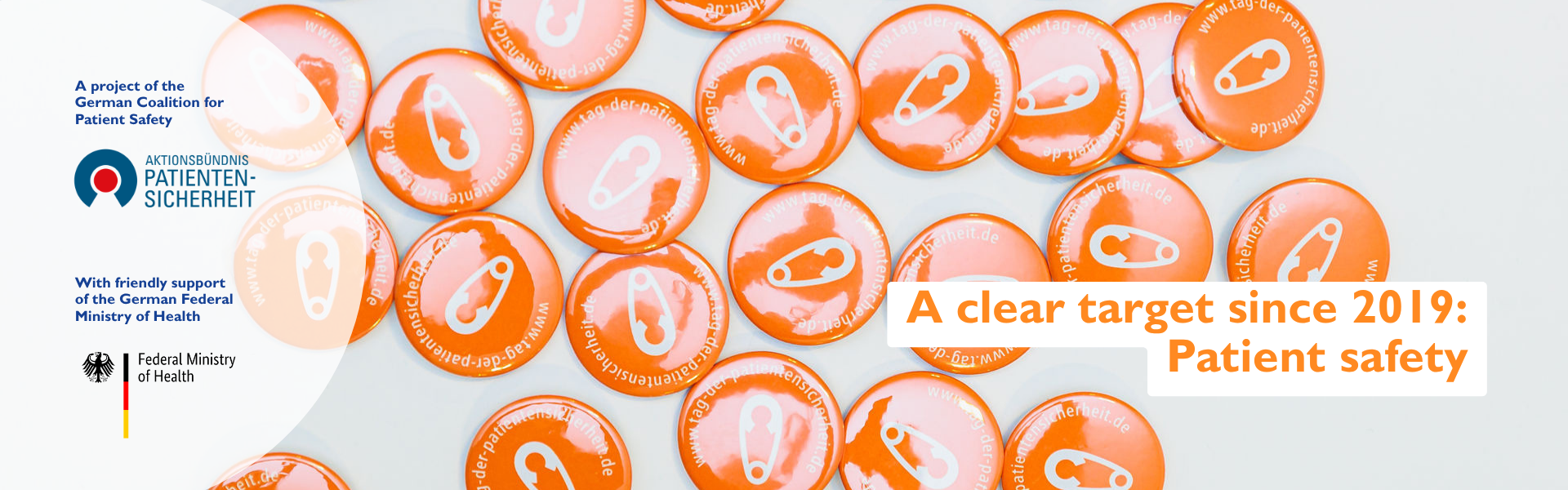
The symbol of World Patient Safety Day: the safety pin and the colour orange
The APS safety pin and the high-visibility orange colour of patient safety symbolise a commitment to raising awareness of patient safety among healthcare professionals and the general public, whilst also calling on everyone to take an active role in improving patient safety.
Every year, the APS calls on people to help raise awareness of this important issue through campaigns and information events centred around World Patient Safety Day. Join in!
What is patient safety?
The overarching aim of patient safety is to improve the quality of healthcare and to ensure that patients do not suffer avoidable harm as a result of medical treatment. Here are some key elements of patient safety:
Error prevention:
Identifying and eliminating potential sources of error in medical care to prevent, for example, misdiagnosis or medical errors such as surgical mix-ups, patient mix-ups or medication errors.
Safety culture:
Promoting an open and transparent culture within healthcare organisations, in which errors and near-misses are reported and used as learning opportunities.
Risk management:
Conducting systematic analyses of treatment processes and outcomes to identify risks and develop measures to minimise them.
Patient involvement:
Involving patients and their relatives in decision-making processes to take their perspectives and experiences into account and enhance the safety of care.
Continuing education and training:
Providing ongoing education and training for healthcare staff to raise their awareness of patient safety and improve their ability to manage safety risks.
Standardisation of procedures:
Implementation of and adherence to guidelines, protocols and standards that promote best practice in patient safety.
Use of technology:
Use of technological solutions, such as electronic health records and computer-based decision support systems, to reduce errors and improve patient safety.
What is the Action Alliance for Patient Safety (APS)?
As a neutral and non-profit organisation, the APS plays a key role in improving patient safety in Germany by disseminating knowledge, fostering dialogue, and offering and supporting concrete measures to prevent errors and minimise risks.
The main activities of the APS include:

Promoting exchange and collaboration:
The APS brings together various stakeholders in the healthcare sector to share knowledge and experience and to develop joint strategies for improving patient safety.

Development of recommendations for action and patient information:
The APS develops and publishes recommendations designed to support healthcare facilities in implementing safety-related measures and to enhance patients’ health literacy.

Education and awareness-raising:
The APS carries out educational work to raise awareness of the importance of patient safety. This is achieved through media coverage, publications, events and campaigns.

Research and projects:
The APS initiates and participates in research projects and studies on patient safety in order to promote evidence-based solutions and innovations.

Policy work:
The APS advocates for the establishment of a national never-event register and contributes to legislative changes by issuing statements and participating in public consultations.
Further information about the Alliance for Patient Safety (APS) can be found on the website:
The main activities of the APS include:
#GermanyRecognisesSepsis
The campaign by the Alliance for Patient Safety and its partners focuses on the prevention, recognition, treatment and aftercare of sepsis. A rapid and accurate diagnosis of sepsis saves lives!
deutschland-erkennt-sepsis.de
Voices for Patient Safety
Patients share their experiences regarding patient safety in video messages. These messages are intended to encourage people to speak up about incidents, to play an active role in their treatment, and to champion a strong culture of safety at every level of the healthcare system.
stimmen-fuer-patientensicherheit.de
APS guidelines and patient information
The guidelines and patient information produced by the APS working groups are available free of charge to healthcare organisations and interested parties.
aps-ev.de/Handlungsempfehlungen
aps-ev.de/Patienteninformationen
Membership and donations
The Action Alliance for Patient Safety (APS) is funded in its core work by membership fees and donations. Currently, around 800 members support the APS. New members are very welcome! You can find information about membership at:
https://www.aps-ev.de/mitmachen/mitglied-werden
You are welcome to support the APS with a donation:
Donations account
Aktionsbündnis Patientensicherheit e.V.
IBAN DE93 3006 0601 0005 5751 11
BIC DAAEDEDDXXX
APO Bank
Project funding
The Federal Ministry of Health is supporting the APS in organising and coordinating World Patient Safety Day in Germany.
Funding reference:
To be announced shortly
Funding amount:
To be announced shortly
Funding period:
To be announced shortly
Funded measures
- 1 HR department (45 %)
- Website tag-der-patientensicherheit.de
- Website patient-safety-day.org
- Public relations
- Press relations, including press conferences
- Provision of digital and print materials free of charge to participating organisations and individuals (flyers, social media kits, guidance documents, patient information, etc.)
- Organisation of the main event on 17 September 2024 in Berlin